
October 13, 2025 | Brandon Hastings
10 min read

Wounds, especially the chronic type, not only have a significant economic impact on our healthcare system but also on patients’ quality of life. Notably, nearly 2.5% of the U.S. population suffers from chronic wounds.
That’s why wound care is a fundamental aspect of medical practice across virtually all disciplines. From the primary care physician managing a chronic leg ulcer to the emergency room nurse treating an acute laceration, treating wounds is a daily reality in a variety of healthcare settings.
But effective and timely wound management is not merely about healing a physical injury—it’s paramount to ensuring positive patient outcomes and significantly reducing the risk of complications such as infection, pain, and scarring.
Enter wound care supplies, the essential components in wound management.
What products should you keep stocked for basic and advanced wound care needs? We delve into specific items and valuable considerations for optimizing your wound care inventory so you can provide the highest standard of care for a diverse range of wound types.
General Principles of Wound Care
Effective wound management relies on several core components.
- Wound assessment: Accurate evaluation of the wound’s type, size, depth, exudate, and infection signs is crucial for guiding treatment.
- Wound cleansing: Gentle yet effective cleansing removes debris and contaminants from the wound bed without causing additional trauma.
- Dressing selection: Choosing the right dressing is vital to create an optimal, moist healing environment, manage exudate, and protect the wound from external threats.
- Infection control: Strict adherence to sterile technique and hygiene is paramount as it prevents microbial contamination and fosters an ideal environment for healing.
Each of the wound care supplies in the following sections aids practitioners like you in addressing these components.
Core Inventory: Essential Wound Care Supplies
A well-stocked foundational inventory is important for effective wound management in any medical practice. These core supplies facilitate initial assessment, cleansing, and dressing application for common wounds.
Wound Cleansing Solutions
- Normal saline (0.9% NaCl): This is the gold standard for most wounds. This isotonic solution is gentle, non-toxic to fibroblasts, and ideal for routine wound irrigation, maintaining a healthy healing environment. Stock individual sterile vials or larger sterile bottles.
- Antiseptics (e.g., chlorhexidine): These are reserved for infected or highly contaminated wounds. Use with caution due to potential cytotoxicity to healthy tissue, which can impede healing. Avoid routine use on clean, granulating wounds.
- Specialized wound cleansers: Beyond saline, consider advanced, non-cytotoxic wound cleansers containing surfactants or polyhexamethylene biguanide (PHMB). These solutions effectively loosen and remove wound debris, exudate, and even biofilm components without harming viable tissue, proving useful for chronic or complex wounds.
Primary Dressings
- Gauze (woven and non-woven): It’s versatile and economical. Woven gauze is absorbent but may adhere, while non-woven is softer, more absorbent, and less linting, so it’s suitable for general coverage and light absorption.
- Non-adherent dressings (e.g., petroleum jelly gauze, silicone coated): These are designed to minimize trauma and pain during removal. Petroleum jelly gauze maintains moisture for superficial wounds. Silicone-coated dressings conform well, gently adhere, and are ideal for fragile skin or frequent changes.
- Thin foam dressings: These absorbent, non-adherent dressings offer cushioning and can manage light to moderate exudate. They provide a moist wound environment, protect the wound, and are comfortable for the patient, making them suitable for a variety of superficial to partial-thickness wounds.
Secondary Dressings & Securement
- Absorbent pads/dressings: These are essential for managing moderate to heavy exudate, protecting underlying skin and clothing from maceration, and providing cushioning.
- Adhesive tapes (paper, silk, cloth, transparent): A range of tapes is necessary for diverse skin sensitivities and securement needs, such as with vertebral body stenting. Paper tape is gentle, silk offers stronger adhesion, cloth is durable, and transparent films allow wound visualization and water resistance.
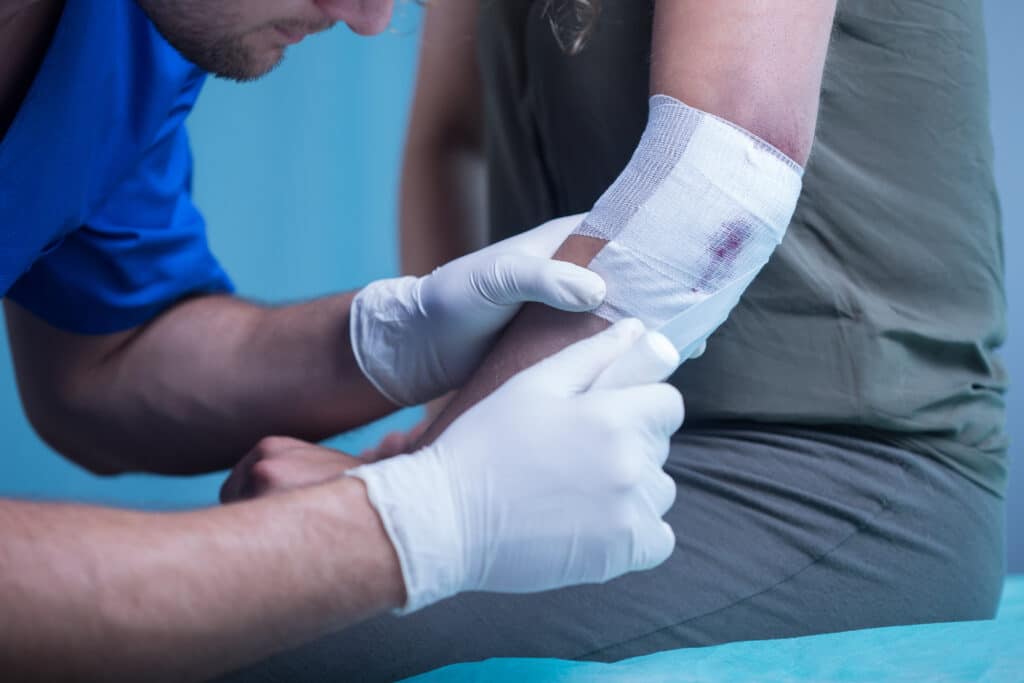
- Conforming bandages (e.g., roller gauze, elastic bandages): These bandages are used to hold primary and secondary dressings in place, providing light compression or support, and conforming easily to body contours, especially around joints.
Personal Protective Equipment (PPE)
- Gloves (sterile and non-sterile): Non-sterile gloves are used for general handling and non-intact skin, while sterile gloves are used for direct wound contact and aseptic procedures to prevent contamination.
- Eye protection, masks, gowns: Each of these items is crucial when there is a risk of splashes, sprays, or aerosols during wound irrigation or debridement. They protect both patients and practitioners from potential exposure.
- Disposable aprons/fluid-resistant gowns: These provide an additional barrier for clothing and skin, which is especially important when dealing with heavily exudating wounds or procedures with significant fluid splash potential.
Basic Instruments
- Sterile scissors and forceps: These are fundamental for precise dressing removal, trimming materials, and appropriate sharp debridement (with proper training). They also help with maintaining aseptic technique.
- Cotton swabs/applicators: Swabs and applicators are useful for targeted cleaning, applying topical agents, and collecting cultures. Always ensure sterility when using them on open wounds.
- Disposable wound measuring guides/rulers: These are simple yet vital tools for accurate and consistent documentation of wound size (length, width, depth) at each assessment, enabling objective tracking of healing progress.
Expanded Inventory: Advanced Wound Care Supplies
Beyond the essentials, a well-equipped practice benefits immensely from a selection of advanced wound care products. These specialized items are engineered to address the complexities of various wound types, optimize the healing environment, and manage specific challenges such as heavy exudate, infection, and non-viable tissue.
Hydrocolloids
- Properties: These occlusive, conformable, self-adhesive dressings create a moist wound environment, absorbing light to moderate exudate to form a gel, and protecting against contaminants.
- Uses: They are ideal for pressure ulcers (stages I-III), minor burns, partial-thickness wounds, and donor sites. Avoid using them on heavily exuding or infected wounds.
Alginates
- Properties: Derived from seaweed, alginates are highly absorbent, forming a soft gel with exudate, and possessing hemostatic properties. A secondary dressing is always required with these products.
- Uses: They are primarily for heavily exuding wounds (e.g., venous leg ulcers, full-thickness, or bleeding wounds) that require packing; they are not suitable for dry wounds.
Foam Dressings
- Properties: Foam dressings come in varying thicknesses. Unlike their thin counterparts described above, these multi-layered dressings are highly absorbent for moderate to heavy exudate, providing cushioning and thermal insulation. They come in adhesive and non-adhesive forms and are permeable to water vapor, yet impermeable to bacteria.
- Uses: They are versatile for wounds with moderate to heavy exudate, for pressure redistribution over bony prominences, protecting fragile periwound skin, and creating a comfortable, protective barrier over various wound types.
Hydrogels
- Properties: Hydrogels hydrate dry wounds. They are soothing and help reduce pain.
- Uses: They are best suited for dry or minimally exuding wounds, slough wounds, painful wounds, and minor burns, though these products require a secondary dressing to hold them in place.
Transparent Films
- Properties: These thin, clear, self-adhesive polyurethane films are selectively permeable, allowing oxygen and water vapor passage while blocking bacteria and contaminants. They maintain a moist environment and allow visual assessment.
- Uses: They are excellent for superficial wounds, clean surgical incisions, donor sites, securing IV catheter sites, and serving as a transparent secondary dressing over other primary dressings.
Antimicrobial Dressings
- Properties: Infused with agents like silver or PHMB, these dressings reduce microbial burden, manage infection, and often inhibit biofilm formation with broad-spectrum activity.
- Uses: They are indicated for infected or critically colonized wounds, or those at high risk of infection displaying local signs.
Collagen Dressings
- Properties: Collagen dressings provide a natural protein scaffold, encouraging cellular migration, proliferation, and new collagen deposition. They absorb exudate and actively stimulate healthy granulation tissue formation, which is crucial for wound closure.
- Uses: They are beneficial for chronic non-healing wounds (e.g., diabetic foot ulcers, pressure ulcers, venous ulcers) stalled in the inflammatory phase and for partial- to full-thickness wounds.
Superabsorbent Dressings
- Properties: These advanced dressings incorporate specialized polymers for maximum fluid retention, managing extremely heavy exudate by locking it away from the wound bed, preventing periwound maceration and reducing dressing change frequency.
- Uses: They are specifically engineered for highly exudative wounds such as heavily draining venous leg ulcers, malignant wounds, or post-surgical wounds with significant fluid output, where maintaining periwound skin integrity is a primary concern.
Debridement Wound Care Supplies
Debridement, the removal of non-viable tissue from a wound, is a critical step in preparing the wound bed for optimal healing. Various methods exist, each requiring specific wound care products.
Surgical Debridement Tools
Sterile scalpels, curettes, and forceps are precise instruments that are used for the rapid and selective removal of necrotic tissue, a procedure that requires appropriate training and expertise by qualified practitioners to ensure safety and effectiveness.
Enzymatic Debriding Agents
Collagenase is an agent that selectively breaks down necrotic tissue, offering a less invasive alternative to surgical removal, and is particularly useful for patients where surgical debridement is contraindicated or impractical.
These agents are especially valuable for wounds presenting with slough or eschar where surgical debridement is either not feasible, too painful, or otherwise contraindicated due to the patient’s condition or the wound’s location.
Autolytic Debridement Aids
In addition to absorbing various amounts of exudate, substances like hydrogels, transparent films, and hydrocolloids can also be used in autolytic debridement. These dressings create a moist wound environment, which is crucial for allowing the body’s own endogenous enzymes to naturally break down and remove necrotic tissue, promoting a gentle and selective debridement process without damaging healthy tissue.
Compression Therapy Supplies
Compression therapy is a cornerstone of management for conditions like venous leg ulcers and lymphedema, crucially promoting venous return, reducing edema, and facilitating healing by improving microcirculation.
Compression Bandages
- Short-stretch bandages: These provide high working pressure when muscles contract and low resting pressure when muscles are relaxed, making them ideal for ambulatory patients with venous insufficiency, effectively supporting the muscle pump.
- Long-stretch bandages: Suitable for less active patients or for sustained compression, these bandages exert high resting pressure, maintaining consistent pressure even at rest.
- Cohesive bandages: These self-adherent bandages offer consistent pressure without slipping, making them excellent outer layers in multi-layer compression systems for secure and effective therapy.
Compression Stockings/Garments
- Medical compression stockings/garments: Essential for long-term, graduated compression, with the highest pressure at the ankle, these stockings manage chronic venous insufficiency and prevent ulcer recurrence effectively.
- Anti-embolism stockings: Specifically designed for non-ambulatory patients, these stockings provide mild, graduated compression to reduce the risk of deep vein thrombosis (DVT).
- Custom-fit garments: Indicated for atypical limb shapes or severe lymphedema, these garments ensure optimal, precise pressure distribution for individualized patient needs.
Diagnostic Tools and Assessment Aids
Accurate diagnosis and ongoing assessment are fundamental to effective wound care. Equipping your practice with appropriate diagnostic tools allows for precise wound characterization and objective monitoring of healing progression.
Wound Measuring Tools
Rulers and disposable wound measurement guides are essential for consistently documenting wound length, width, and depth, which provides objective data for tracking healing over time. Wound measurement software, particularly modern AI-powered wound imaging platforms, are more accurate than paper and rulers, but they do come with an additional expense.
Photography Equipment
A digital camera is used for standardized wound photography, offering a visual record for documentation, communication with specialists, and monitoring progress or deterioration.
Doppler for Ankle-Brachial Index (ABI)
A portable doppler device is essential for assessing arterial flow in patients, especially those with lower extremity wounds. Performing an ABI is crucial before applying compression therapy to ensure sufficient blood flow.
Elevating Patient Care Though Careful Wound Supply Management
Maintaining a comprehensive and well-managed inventory of wound care supplies is vital for any medical practice. Remember that having the right supplies isn’t just about efficiency—it directly translates to better patient comfort, faster healing times, and ultimately, improved patient outcomes.
THE FUTURE OF CARE
Your Guide to Restorative Healthcare Trends
Stay ahead in the ever-evolving healthcare industry with our new Trends Hub. Explore cutting-edge insights and the latest developments shaping the future of care. Your go-to destination for staying informed, inspired, and ready to innovate.